

Photo: No machine-readable author provided. Wikipedia-ce assumed (based on copyright claims)., Public domain via Wikimedia Commons Source
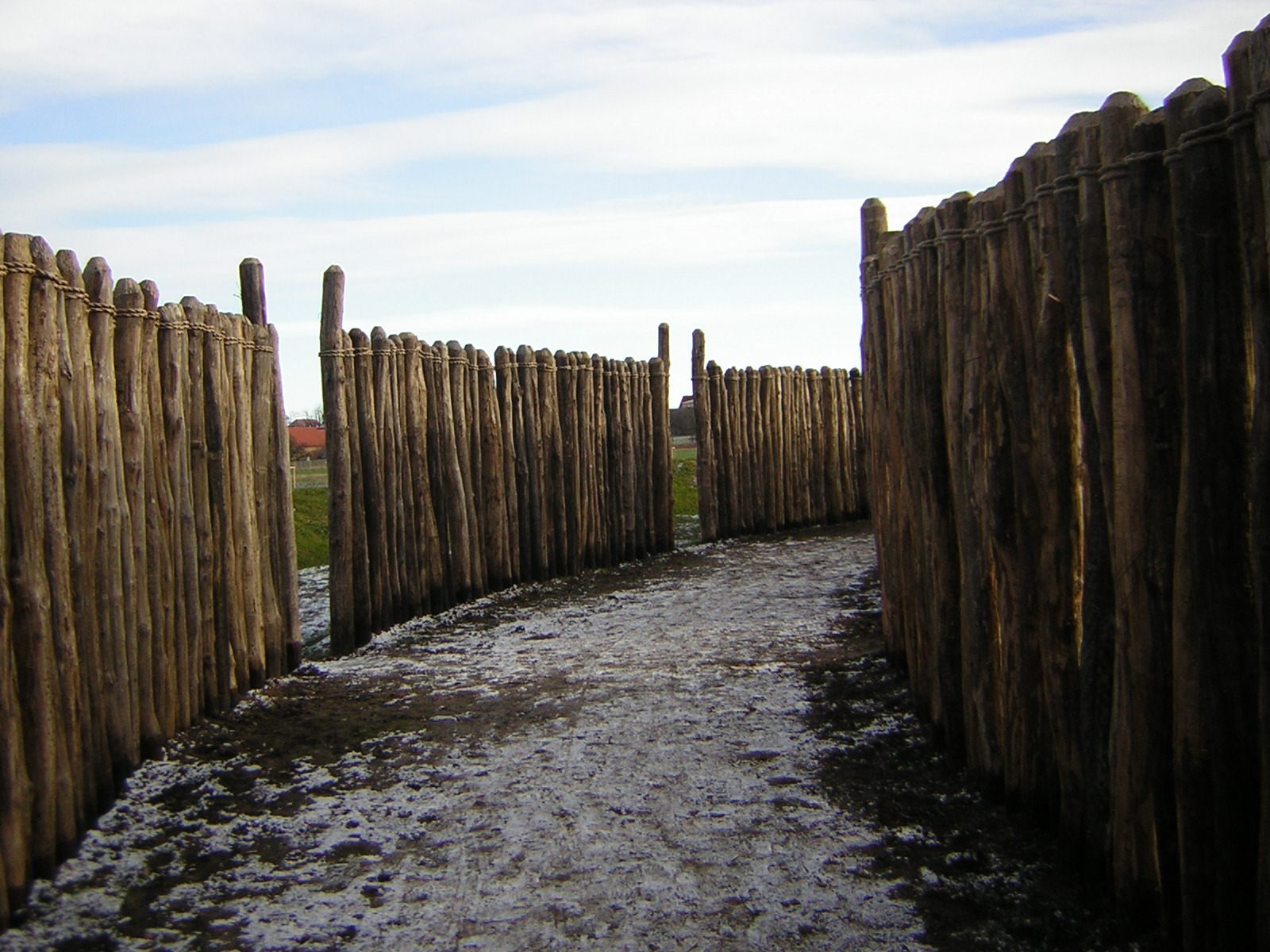
A circular ditched enclosure in Saxony-Anhalt aligned on the winter solstice. It dates from the 49th century BC. It is a protected cultural monument (Kulturdenkmal).
- Country
- Germany
- Region
- Europe
- Period
- about 4900 BC
- Kind of site
- Rondel enclosure, human settlement
- Dates from
- 49th century BC
- Heritage status
- Kulturdenkmal
- Located in
- Goseck, Germany
- Coordinates
- 51.1983° N, 11.8647° EWikipedia and Wikidata agree within 0.0 km
- Reference
- Wikidata Q675018
- Encyclopedia
- Wikipedia article
About this place
The Goseck Circle is a Neolithic structure in Goseck in the Burgenlandkreis district in Saxony-Anhalt, Germany. It was constructed around 4900 BC, and appears to have remained in use until around 4700 BC. Thus, it may be the oldest and best known of the circular enclosures associated with the Central European Neolithic. Currently, the site is presented officially by the state archaeologists and the local association that looks after it as a ritual or cult structure. The circle consists of a concentric ditch 75 meters (246 feet) across and two palisade rings containing entrances in places aligned with sunrise and sunset on the winter solstice days and smaller entrances aligned with the summer solstice. Marketing materials have described the site as one of the oldest "Solar observatories" in the world, but sunrise and sunset during winter and summer solstices are the only evident astronomical alignments emphasized in the remains of the structure.
Adapted from the Wikipedia article Goseck Circle (this version), lightly edited for style, under the CC BY-SA 4.0 license.
Nearby places
Open in the Atlas →- Steinernes Album 5.4 km (3.4 mi)
- Menhire von Wethau 6.4 km (4.0 mi)
- Frankleben hoard 12 km (8 mi)
- Bad Dürrenberg burial 17 km (11 mi)
- Burial ground of Rössen 18 km (11 mi)
- Grabhügel von Rössen 18 km (11 mi)














Recent comments