

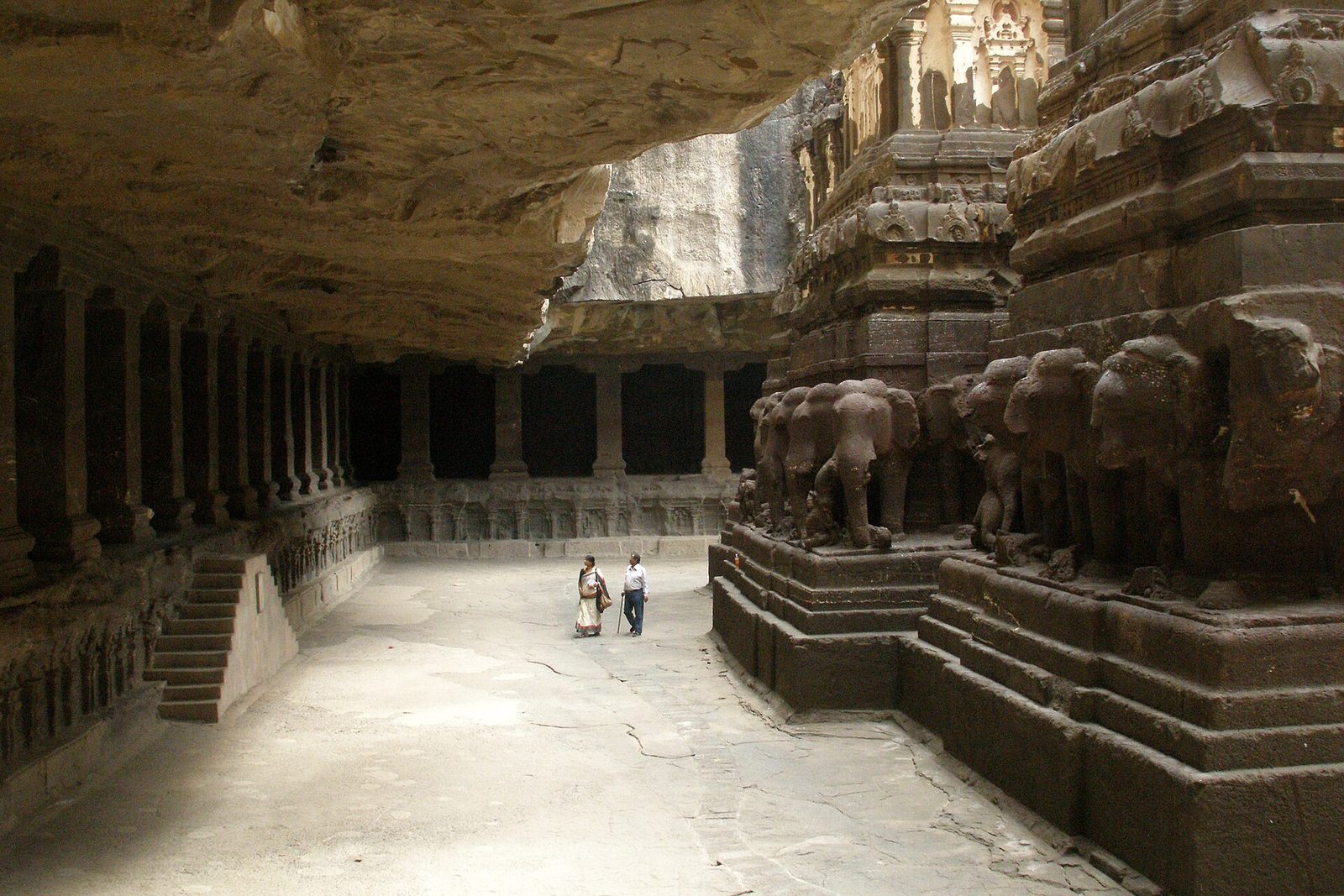
Photo: Vyacheslav Argenberg, CC BY 4.0 via Wikimedia Commons Source
Rock-cut Buddhist, Hindu and Jain temples, including the Kailasa temple cut from a single rock. It is a UNESCO World Heritage Site.
- Country
- India
- Region
- Asia
- Period
- AD 600 to 1000
- Kind of site
- Cave, archaeological site
- Heritage status
- World Heritage Site; Monument of National Importance
- Located in
- Aurangabad district, India
- Also known as
- Elora
- Coordinates
- 20.0268° N, 75.1771° EWikipedia and Wikidata agree within 0.22 km
- UNESCO
- World Heritage site 243
- Reference
- Wikidata Q189616
- Encyclopedia
- Wikipedia article
About this place
The Ellora Caves are a UNESCO World Heritage Site in Aurangabad, India. It is one of the largest rock-cut cave complexes in the world, with artwork dating from AD 600 to 1000, including Hindu, Buddhist, and Jain caves. The complex is a leading example of Indian rock-cut architecture, and several are not strictly "caves" in that they have no roof. Cave 16 features the largest single monolithic rock excavation in the world, the Kailash temple, a chariot-shaped monument dedicated to the god Shiva. The Kailash temple excavation also features sculptures depicting various Hindu deities as well as relief panels summarizing the two major Hindu epics. There are over 100 caves at the site, all excavated from the basalt cliffs in the Charanandri Hills, 34 of which are open to the public.
Adapted from the Wikipedia article Ellora Caves (this version), lightly edited for style, under the CC BY-SA 4.0 license.
Nearby places
Open in the Atlas →- Ajanta Caves 80 km (50 mi)
- Ambivali Caves 209 km (130 mi)
- Chichali 235 km (146 mi)
- Tandulwadi Fort 249 km (154 mi)
- Mandu 258 km (160 mi)
- Wai Caves 265 km (164 mi)














Recent comments