

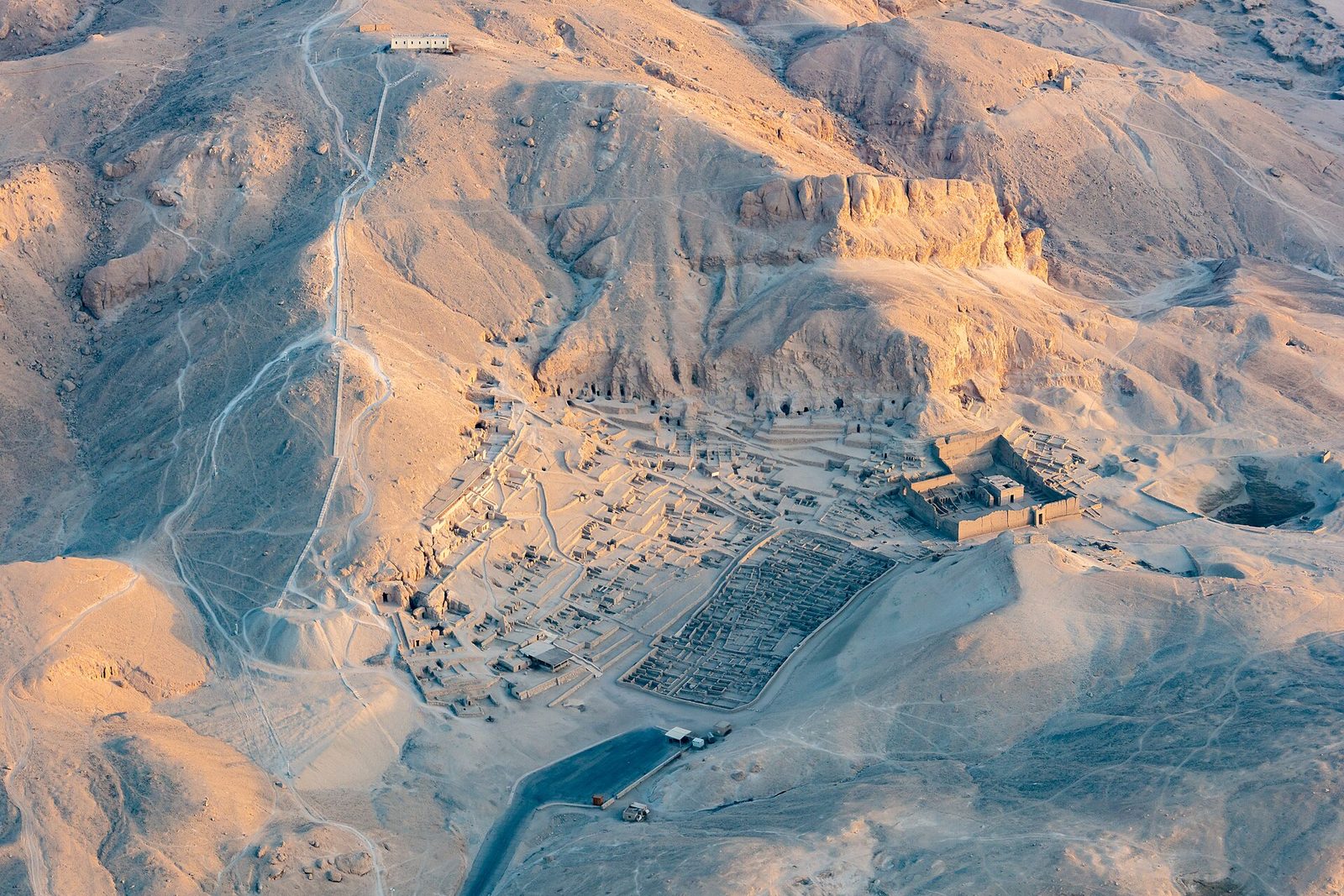
Photo: Diego Delso, CC BY-SA 4.0 via Wikimedia Commons Source
The village of the workmen who built the royal tombs. It is associated with the Egyptian Empire and Ancient Egypt.
- Country
- Egypt
- Region
- Africa
- Period
- about 1550 to 1070 BC
- Kind of site
- Necropolis, human settlement, archaeological site
- Period or culture
- Egyptian Empire, Ancient Egypt
- Located in
- Qurnah District, Egypt
- Also known as
- Set Maat; Valley of the Artisans
- Coordinates
- 25.7283° N, 32.6014° EWikipedia and Wikidata agree within 0.0 km
- Reference
- Wikidata Q750212
- Encyclopedia
- Wikipedia article
About this place
Deir el-Medina, or Dayr al-Madīnah, is an ancient Egyptian workmen's village which was home to the artisans who worked on the tombs in the Valley of the Kings during the 18th to 20th Dynasties of the New Kingdom of Egypt (ca. 1550 to 1080 BC). The settlement's ancient name was Set maat ("Place of Truth"), and the workmen who lived there were called "Servants in the Place of Truth". During the Christian era, the temple of Hathor was converted into a Monastery of Saint Isidorus the Martyr (Coptic: ⲡⲧⲟⲡⲟⲥ ⲙ̄ⲫⲁⲅⲓⲟⲥ ⲁⲡⲁ ⲓⲥⲓⲇⲱⲣⲟⲥ ⲡⲙⲁⲣⲧⲉⲣⲟⲥ) from which the Egyptian Arabic name Deir el-Medina ("Monastery of the City") is derived. At the time when the world's press was concentrating on Howard Carter's discovery of the Tomb of Tutankhamun in 1922, a team led by Bernard Bruyère began to excavate the site.
Adapted from the Wikipedia article Deir el-Medina (this version), lightly edited for style, under the CC BY-SA 4.0 license.
Nearby places
Open in the Atlas →- Topos of Saint Mark 0.3 km (0.2 mi)
- Qurnet Murai 0.4 km (0.2 mi)
- Valley of Colors 0.5 km (0.3 mi)
- Valley of the Three Pits 0.5 km (0.3 mi)
- MMA 1016 0.5 km (0.3 mi)
- Theban Necropolis 0.6 km (0.4 mi)














Recent comments