

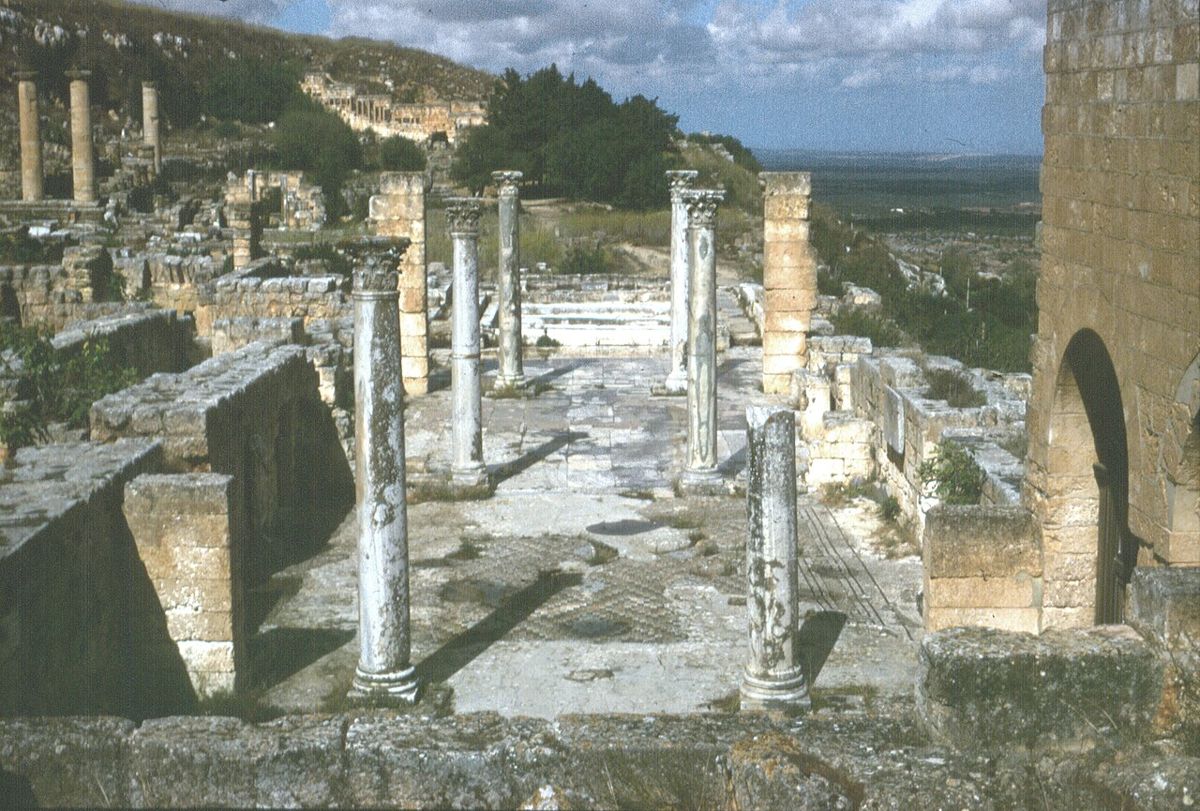
Photo: MM, Public domain via Wikimedia Commons Source
Cyrene is an ancient Greek and Roman city near present-day Shahhat, Libya. It dates from 630 BC. It is a UNESCO World Heritage Site.
- Country
- Libya
- Region
- Africa
- Period
- Around 630 BC
- Kind of site
- Greek colony, municipality of Libya, emporium
- Dates from
- 630 BC
- Heritage status
- World Heritage Site
- Located in
- Libya
- Also known as
- Cyrene, Libya; Mint of Cyrene
- Coordinates
- 32.8167° N, 21.8500° ECoordinates from Wikidata
- UNESCO
- World Heritage site 190
- Reference
- Wikidata Q44112
- Encyclopedia
- Wikipedia article
About this place
Cyrene, also sometimes anglicized as Kyrene, was an ancient Greek colony and Roman city near present-day Shahhat in northeastern Libya in North Africa. It was part of the Pentapolis, an important group of five cities in the region, and gave the area its classical and early modern name Cyrenaica. Cyrene lies on a ridge of the Jebel Akhdar uplands. The archaeological remains cover several hectares and include several monumental temples, stoas, theaters, bathhouses, churches, and palatial residences. The city is surrounded by the Necropolis of Cyrene. Since 1982, it has been a UNESCO World Heritage Site. The city's port was Apollonia (Marsa Sousa), located about 16 kilometers (10 mi) to the north. The city was attributed to Apollo and the legendary etymon Cyrene by the Greeks themselves but it was probably actually colonized by settlers from Thera (modern Santorini) in the late seventh century BC.
Adapted from the Wikipedia article Cyrene, Libya (this version), lightly edited for style, under the CC BY-SA 4.0 license.
Nearby places
Open in the Atlas →- Extramural Sanctuary of Demeter and Persephone at Cyrene, Libya 0.3 km (0.2 mi)
- Temple of Apollo in Cyrene 0.6 km (0.3 mi)
- Theater 5, Cyrene 0.6 km (0.4 mi)
- House of Jason Magnus, Cyrene 0.7 km (0.4 mi)
- Theater 3, Cyrene 0.8 km (0.5 mi)
- Theater 2, Cyrene 0.8 km (0.5 mi)
Place data from Wikidata (CC0). Ancient Origins has not yet reviewed this entry in depth.














Recent comments