

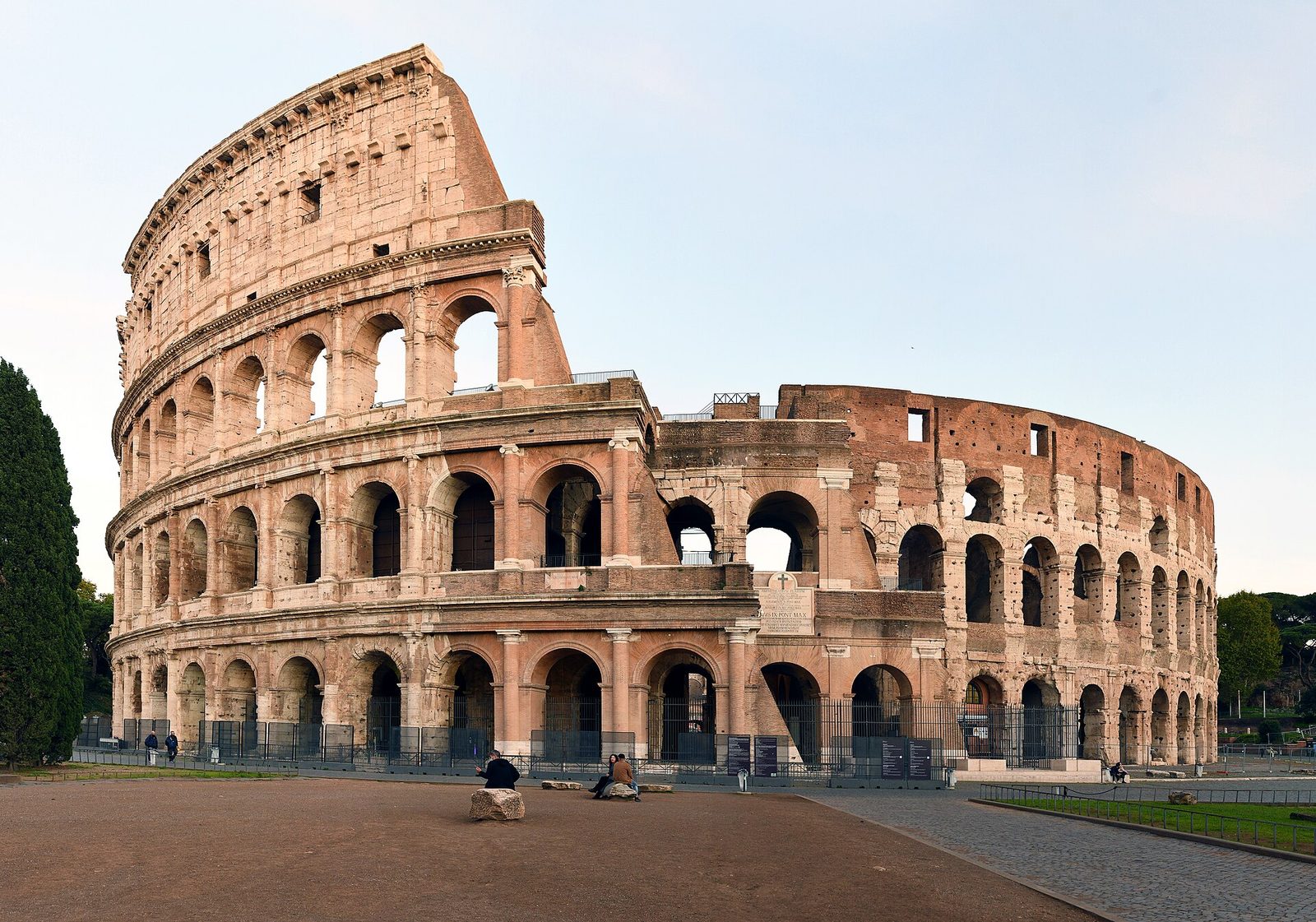
Photo: FeaturedPics, CC BY-SA 4.0 via Wikimedia Commons Source
The Colosseum, or Flavian Amphitheater, is the great arena in the center of Rome, Italy. Begun under the emperor Vespasian in the AD 70s, it was opened by his son Titus in AD 80 and could hold perhaps 50,000 spectators. It hosted gladiator fights and public shows for centuries and remains the largest amphitheater ever built.
The great amphitheater of Rome, seating perhaps 50,000 spectators for games and spectacles. It dates from AD 80 and is associated with Ancient Rome. It is part of Italy's national heritage.
- Country
- Italy
- Region
- Europe
- Period
- completed AD 80
- Kind of site
- Roman amphitheater, stadium, roman ruins
- Dates from
- AD 80
- Period or culture
- Ancient Rome
- Heritage status
- Italian national heritage
- Part of
- archaeological park of Colosseum
- Located in
- Roma Capitale, Italy
- Also known as
- Flavian Amphitheater; Roman Colosseum; Roman Coliseum; Coliseum; Flavius amphitheater
- Coordinates
- 41.8903° N, 12.4922° EWikipedia and Wikidata agree within 0.0 km
- Reference
- Wikidata Q10285
- Encyclopedia
- Wikipedia article
About this place
The Colosseum is an elliptical amphitheater in the center of the city of Rome, Italy, just east of the Roman Forum. It is the largest ancient amphitheater ever built, and is the largest standing amphitheater in the world. Construction began under the Emperor Vespasian (r. 69 to 79 AD) in 72 and was completed in AD 80 under his successor and heir, Titus (r. 79 to 81). Further modifications were made during the reign of Domitian (r. 81 to 96). The three emperors who were patrons of the work are known as the Flavian dynasty, and the amphitheater was named the Flavian Amphitheater (Latin: Amphitheatrum Flavium; Italian: Anfiteatro Flavio [aɱfiteˈaːtro ˈflaːvjo]) by later classicists and archaeologists for its association with their family name (Flavius). The Colosseum is built of travertine, Roman concrete (foundations, corridors vaults and secondary brick walls), and tuff (volcanic rock).
Adapted from the Wikipedia article Colosseum (this version), lightly edited for style, under the CC BY-SA 4.0 license.
Nearby places
Open in the Atlas →- Arch of Titus 0.3 km (0.2 mi)
- Parco archeologico del Celio 0.3 km (0.2 mi)
- Domus Liceo Cavour 0.4 km (0.2 mi)
- Baths of Trajan 0.4 km (0.2 mi)
- Roman houses of the Caelian 0.4 km (0.3 mi)
- Library of Pope Agapito I 0.4 km (0.3 mi)














Recent comments