

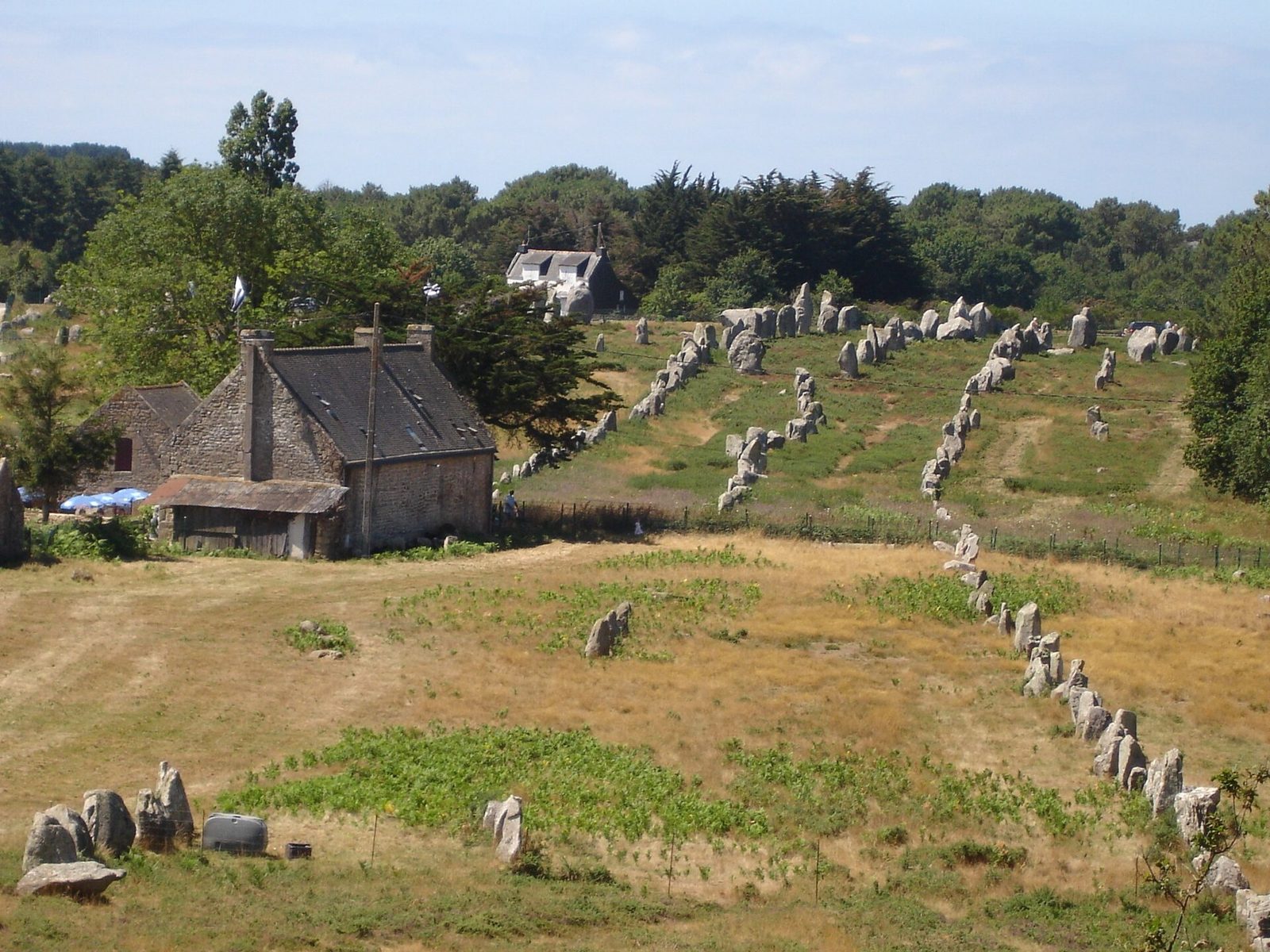
Photo: --Pinpin 17:43, 1 August 2006 (UTC), CC BY-SA 3.0 via Wikimedia Commons Source
More than 3,000 standing stones in long rows in Brittany, the largest megalithic site of its kind. It is associated with the Neolithic. It is part of a UNESCO World Heritage Site.
- Country
- France
- Region
- Europe
- Period
- about 4500 to 3300 BC
- Kind of site
- Stone row, archaeological site
- Period or culture
- Neolithic
- Heritage status
- Classified historical monument; Part of UNESCO World Heritage Site
- Located in
- Carnac, France
- Coordinates
- 47.5972° N, 3.0639° WWikipedia and Wikidata agree within 1.26 km
- UNESCO
- World Heritage site 1725
- Reference
- Wikidata Q833850
- Encyclopedia
- Wikipedia article
About this place
The Carnac stones are an exceptionally dense collection of megalithic sites near the south coast of Brittany in northwestern France, consisting of stone alignments, dolmens, tumuli, and single menhirs. More than 3,000 prehistoric standing stones were hewn from local granite and erected by the pre-Celtic people of Brittany and form the largest such collection in the world. Most of the stones are within the Breton municipality of Carnac, but some to the east are within neighboring La Trinité-sur-Mer. Numerous megaliths and tumuli are also found in the surrounding areas, such as at Locmariaquer and Arzon, and on islands in the Gulf of Morbihan (e.g. Gavrinis). The stones were erected at some stage during the Neolithic period, probably around 3300 BC, but some may date to as early as 4500 BC.
Adapted from the Wikipedia article Carnac stones (this version), lightly edited for style, under the CC BY-SA 4.0 license.
Nearby places
Open in the Atlas →- Tumulus, quadrilatère et menhir de Manio 0.7 km (0.4 mi)
- Dolmen de Roch-Vihan 0.8 km (0.5 mi)
- Menhir de Kerluhir 0.8 km (0.5 mi)
- Alignement de Toulchignan 0.8 km (0.5 mi)
- Géant du Manio 0.9 km (0.6 mi)
- Villa des Bosseno 1.0 km (0.6 mi)














Recent comments