

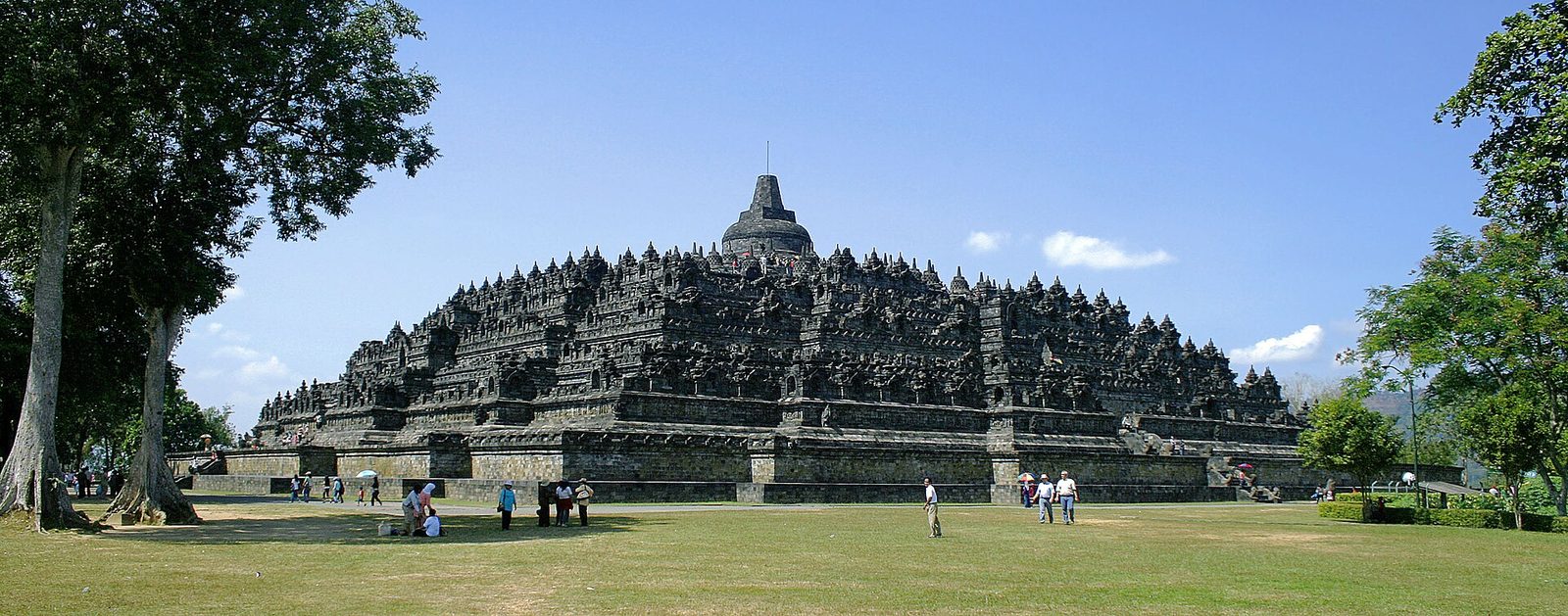
Photo: Gunawan Kartapranata, Public domain via Wikimedia Commons Source
The largest Buddhist temple in the world, a stepped mandala of carved terraces on Java. It dates from the 8th century AD. It is part of a UNESCO World Heritage Site.
- Country
- Indonesia
- Region
- Asia
- Period
- 9th century AD
- Kind of site
- Buddhist temple, Candi, archaeological site
- Dates from
- 8th century AD
- Heritage status
- Part of UNESCO World Heritage Site
- Part of
- Borobudur Temple Compounds
- Architect or builder
- Gunadharma
- Located in
- Magelang, Indonesia
- Also known as
- Boro Budor; Candi Borobudur
- Coordinates
- 7.6080° S, 110.2040° EWikipedia and Wikidata agree within 0.02 km
- Reference
- Wikidata Q42798
- Encyclopedia
- Wikipedia article
About this place
Borobudur, also transcribed Barabudur, is a 9th-century Mahayana Buddhist temple in Magelang Regency, near the town of Muntilan, northwest of the city of Yogyakarta, in Central Java, Indonesia. Constructed of gray andesite-like stone, the temple consists of nine stacked platforms, six square and three circular, topped by a central dome. It is decorated with 2,672 relief panels and originally 504 Buddha statues. The central dome is surrounded by 72 Buddha statues, each seated inside a perforated stupa. The monument guides pilgrims through an extensive system of stairways and corridors with 1,460 narrative relief panels on the walls and the balustrades. Borobudur has one of the world's most extensive collections of Buddhist reliefs. Built during the reign of the Sailendra dynasty, the temple design follows Javanese Buddhist architecture, which blends the Indonesian indigenous tradition of ancestor worship and the Buddhist concept of attaining nirvāṇa.
Adapted from the Wikipedia article Borobudur (this version), lightly edited for style, under the CC BY-SA 4.0 license.
Nearby places
Open in the Atlas →- Pawon 1.8 km (1.1 mi)
- Mendut Temple 2.9 km (1.8 mi)
- Candi Losari 4.0 km (2.5 mi)
- Ngawen 7.5 km (4.7 mi)
- Gunung Wukir 11 km (7 mi)
- Candi Asu 19 km (12 mi)














Recent comments