

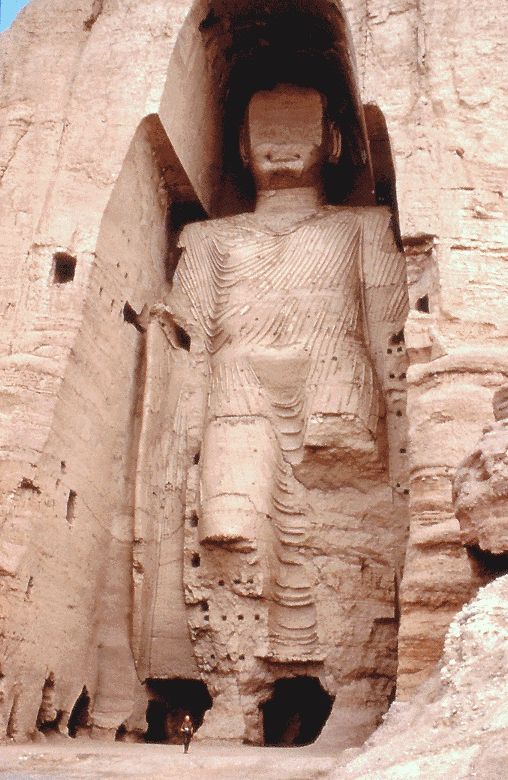
Photo: James Gordon, CC BY 4.0 via Wikimedia Commons Source
Two colossal Buddha statues carved into a cliff, destroyed by the Taliban in 2001. It is associated with Greco-Buddhism. It is part of a UNESCO World Heritage Site.
- Country
- Afghanistan
- Region
- Asia
- Period
- AD 6th century
- Kind of site
- Lost sculpture, destroyed artwork, daibutsu
- Period or culture
- Greco-Buddhism
- Heritage status
- Part of UNESCO World Heritage Site
- Part of
- Cultural Landscape and Archaeological Remains of the Bamiyan Valley
- Located in
- Bamyan Province, Afghanistan
- Also known as
- Salsal; Shahmama
- Coordinates
- 34.8320° N, 67.8267° EWikipedia and Wikidata agree within 0.01 km
- Reference
- Wikidata Q484458
- Encyclopedia
- Wikipedia article
About this place
The Buddhas of Bamiyan were two monumental Buddhist reliefs in the Bamiyan Valley of what is now Afghanistan, carved possibly around the 6th-century. Located 130 kilometers (81 mi) to the northwest of Kabul, at an elevation of 2,500 meters (8,200 ft), carbon dating of the structural components of the Buddhas has determined the smaller 38 m (125 ft) "Eastern Buddha" was built around 570 CE, and the larger 55 m (180 ft) "Western Buddha" was built around 618, which would date both to the time when the Hephthalites ruled the region. In March 2001, both structures were destroyed by the Taliban following an order given on February 26, 2001, by Taliban leader Mullah Muhammad Omar, to destroy all the statues in Afghanistan "so no one can worship or respect them in the future".
Adapted from the Wikipedia article Buddhas of Bamiyan (this version), lightly edited for style, under the CC BY-SA 4.0 license.
Nearby places
Open in the Atlas →- Fondukistan Monestary 97 km (60 mi)
- Khair Khaneh 120 km (75 mi)
- Paitava 125 km (78 mi)
- Tepe Narenj 130 km (81 mi)
- Kabul hoard 130 km (81 mi)
- Bagram Hoard 135 km (84 mi)














Recent comments