

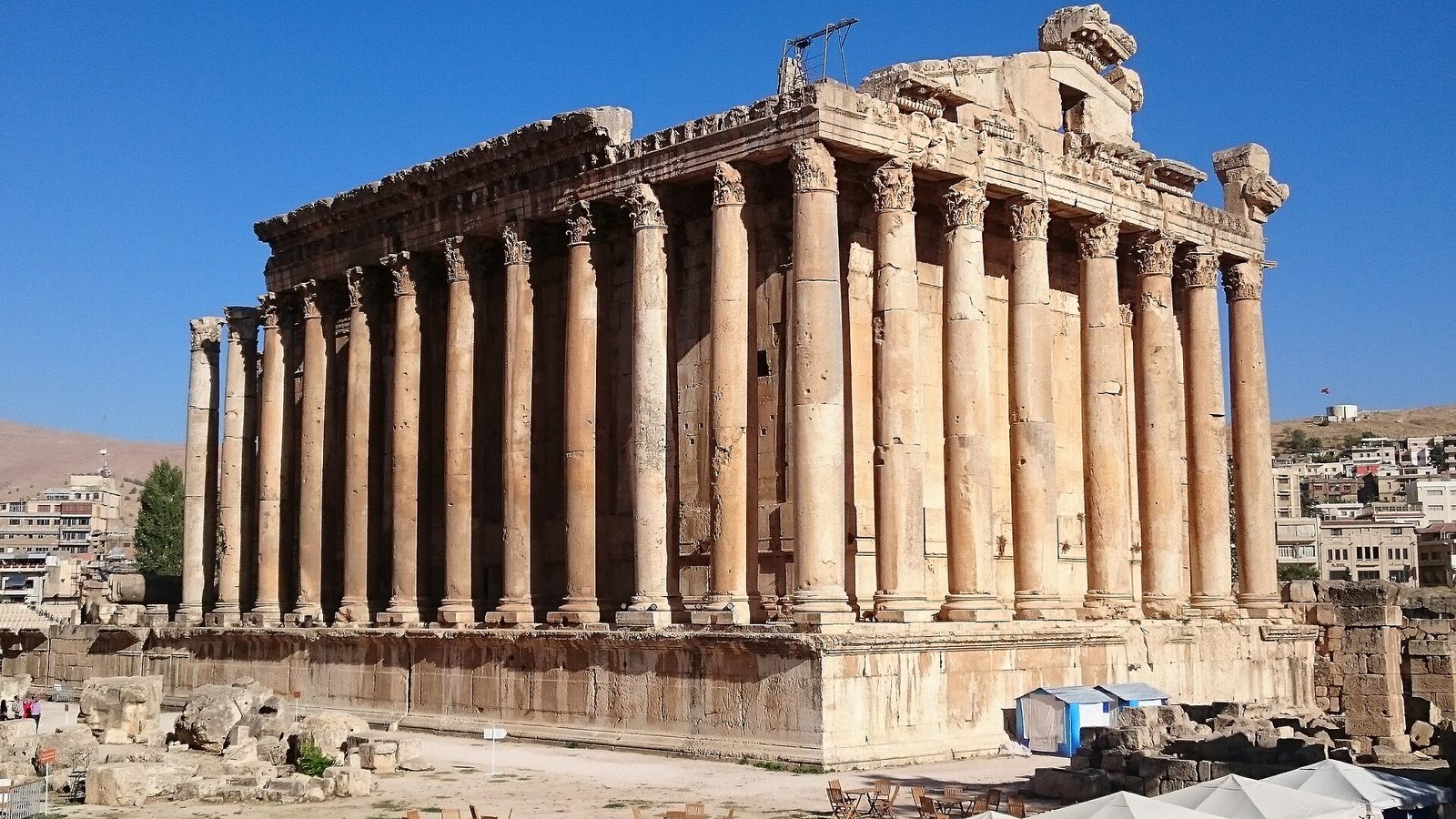
Photo: Saadedine AL SAIDI, CC BY-SA 4.0 via Wikimedia Commons Source
Roman temples of Jupiter and Bacchus set on a platform with some of the largest cut stones ever moved. It is a UNESCO World Heritage Site.
- Country
- Lebanon
- Region
- Asia
- Period
- 1st century BC to AD 3rd century
- Kind of site
- City, ancient city, archaeological site
- Heritage status
- World Heritage Site
- Located in
- Baalbek District, Lebanon
- Also known as
- Baalbeck; Balbec; Baalbec; Heliopolis; Mint of Heliopolis
- Coordinates
- 34.0063° N, 36.2073° EWikipedia and Wikidata agree within 0.12 km
- UNESCO
- World Heritage site 294
- Reference
- Wikidata Q178835
- Encyclopedia
- Wikipedia article
About this place
Baalbek is a city located east of the Litani River in Lebanon's Beqaa Valley, about 67 km northeast of Beirut. It is the capital of Baalbek-Hermel Governorate. In 1998, the city had a population of 82,608. Most of the population consists of Shia Muslims, followed by Sunni Muslims and Christians; in 2017, there was also a large presence of Syrian refugees. Baalbek's history dates back at least 11,000 years. After Alexander the Great conquered the city in 334 BCE, he renamed it Heliopolis (Ancient Greek: Ἡλιούπολις, romanized: Hēlioúpolis, lit. 'Sun City'; Syriac: ܐܝܠܝܘܦܘܠܝܣ, romanized: ʾĪliyōp̄ōlīs). The city flourished under Roman rule. However, it underwent transformations during the Christianization period and the subsequent rise of Islam following the Arab conquest in the 7th century.
Adapted from the Wikipedia article Baalbek (this version), lightly edited for style, under the CC BY-SA 4.0 license.
Nearby places
Open in the Atlas →- Temple of Bacchus 0.3 km (0.2 mi)
- Acropole 0.3 km (0.2 mi)
- Temple of Jupiter 0.4 km (0.2 mi)
- Tell Addus 5.4 km (3.4 mi)
- Tell Safiyeh 6.6 km (4.1 mi)
- Tell Majdaloun 7.9 km (4.9 mi)














Recent comments