

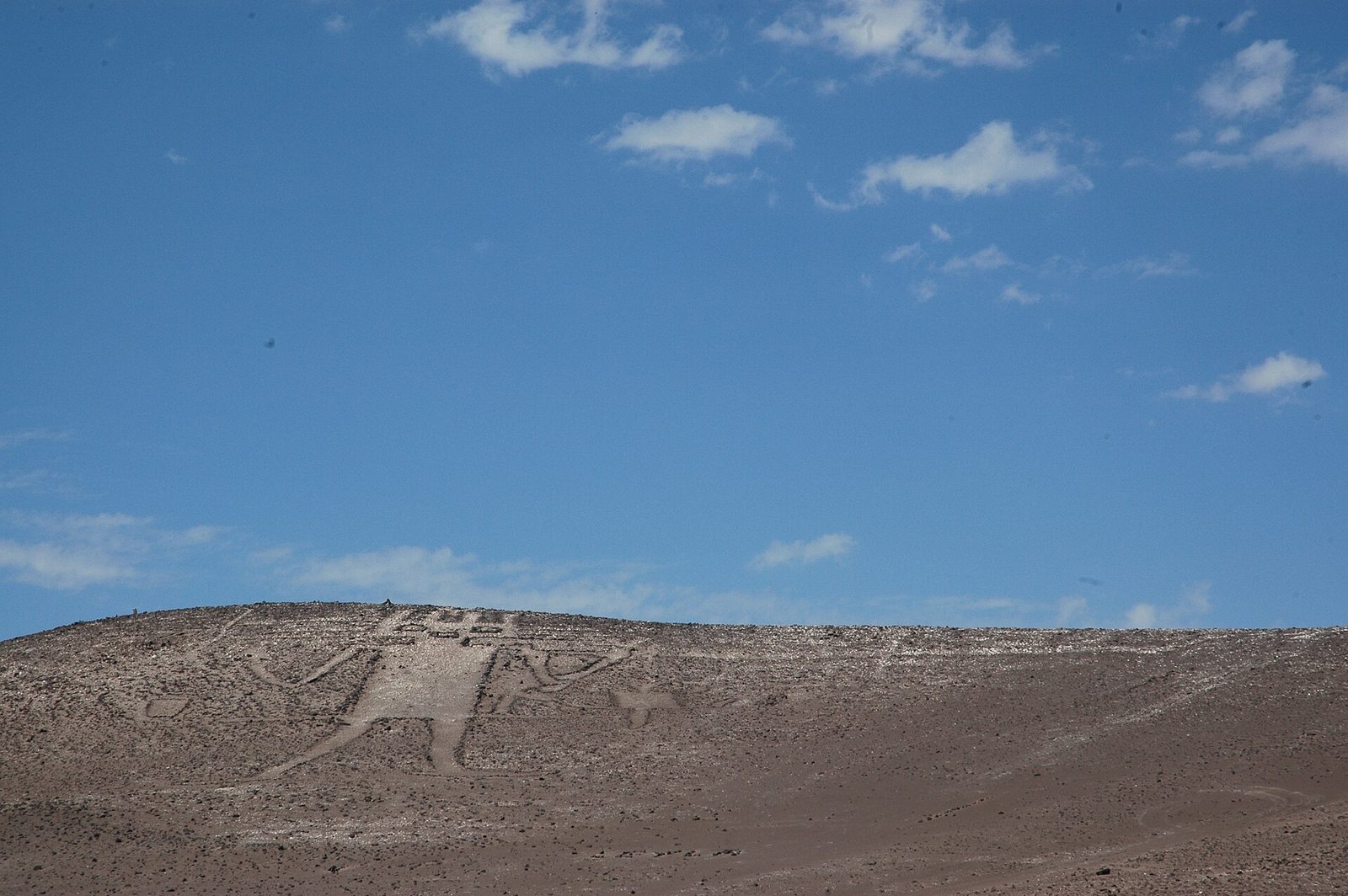
Photo: Emilio Erazo-Fischer (Flickr profile), CC BY-SA 2.0 via Wikimedia Commons Source
The largest prehistoric human figure geoglyph, on a hill in the Atacama Desert. It dates from the 11th century AD.
- Country
- Chile
- Region
- Americas
- Period
- about AD 1000 to 1400
- Kind of site
- Geoglyph, archaeological site
- Dates from
- 11th century AD
- Located in
- Huara, Chile
- Also known as
- Gigante de Atacama; Gigante de Tarapaca
- Coordinates
- 19.9489° S, 69.6331° WWikipedia and Wikidata agree within 0.0 km
- Reference
- Wikidata Q1156421
- Encyclopedia
- Wikipedia article
About this place
The Atacama Giant is an anthropomorphic geoglyph on the Cerro Unita area of the Atacama Desert, Chile. At about 119 meters (390 feet), is the largest prehispanic anthropomorphic geoglyph. It has been suggested that it represents a shaman, spiritual figure or deity. The Atacama Giant is one out of nearly 5,000 geoglyphs (ancient artwork that is drawn into the landscape) that have been discovered in the Atacama region in the last three decades. It is believed that they are the work of several successive cultures that dwelt in this region of South America, including the Tiwanaku and Inca. The Atacama Giant was built some time between 1000 and 1400 CE. One suggested explanation for the figure's features and function is that the alignment of the points on the top and side of the head with the moon helped to determine the season, which was useful since knowing when the rainy season would come was crucial in the barren desert.
Adapted from the Wikipedia article Atacama Giant (this version), lightly edited for style, under the CC BY-SA 4.0 license.
Nearby places
Open in the Atlas →- Geoglifos de Pintados 75 km (46 mi)
- Tambo de Zapahuira 177 km (110 mi)
- Sajama Lines 211 km (131 mi)
- Laqaya 223 km (138 mi)
- Wila Wilani 234 km (145 mi)
- Miculla petroglyphs 236 km (147 mi)














Recent comments