

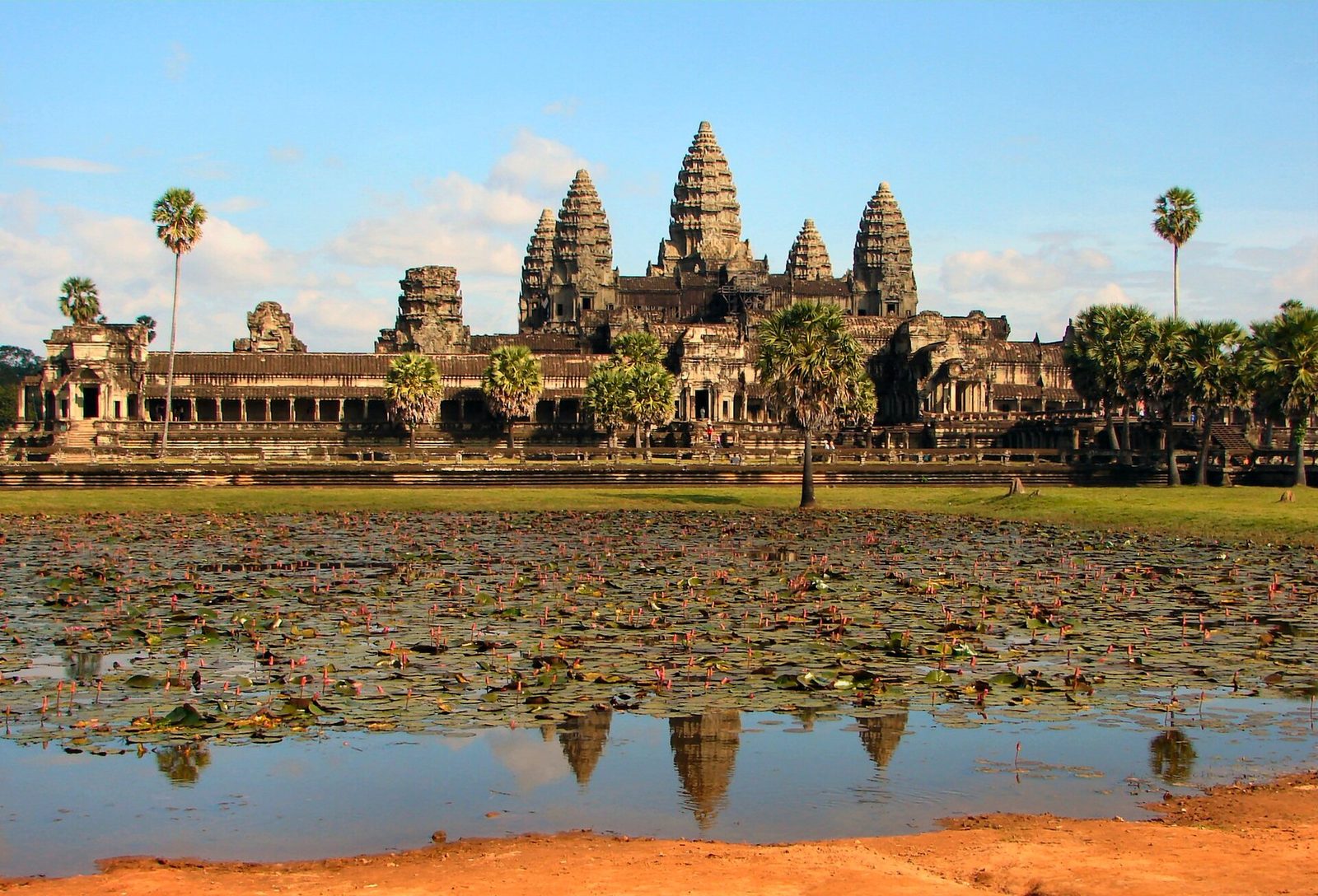
Photo: Bjørn Christian Tørrissen, CC BY-SA 4.0 via Wikimedia Commons Source
Angkor Wat is a vast temple complex near Siem Reap in northern Cambodia. It was built in the early 12th century AD for the Khmer king Suryavarman II and dedicated to the Hindu god Vishnu, and later became a Buddhist temple. It is often described as the largest religious monument in the world and appears on Cambodia's national flag.
The largest religious monument in the world, built for Suryavarman II. It dates from the 12th century AD. It is part of Angkor.
- Country
- Cambodia
- Region
- Asia
- Period
- early 12th century AD
- Kind of site
- Buddhist temple, temple complex, Hindu temple
- Dates from
- 12th century AD
- Part of
- Angkor, Angkor
- Located in
- Siem Reap Province, Cambodia
- Also known as
- Nokor Wat; Prasat Angkor Wat; Temple City; City of Temples; Vrah Viṣṇuloka
- Coordinates
- 13.4125° N, 103.8670° EWikipedia and Wikidata agree within 0.0 km
- Reference
- Wikidata Q43473
- Encyclopedia
- Wikipedia article
About this place
Angkor Wat is a Theravada Buddhist temple complex, originally built as a Vaishnava Hindu temple, in Siem Reap, Cambodia. It is the largest religious complex in the world. Located on a site measuring 162.6 hectares (1.6 km2; 401.8 acres) within the medieval capital of Angkor, it was constructed between 1113 and 1150 CE during the reign of the Khmer king Suryavarman II as a Hindu temple dedicated to Vishnu. From the late 13th century onward, the complex was gradually transformed into a Buddhist temple as Khmer kings adopted Buddhism. Angkor Wat has remained a Buddhist monastery and an active center of Buddhist worship into the present day. It is noted for its monumental scale and extensive bas-reliefs and an architectural unity characteriztic of Khmer architecture.
Adapted from the Wikipedia article Angkor Wat (this version), lightly edited for style, under the CC BY-SA 4.0 license.
Nearby places
Open in the Atlas →- Ta Prohm Kel 0.9 km (0.6 mi)
- Baksei Chamkrong 1.7 km (1.1 mi)
- Phnom Bakheng 1.7 km (1.1 mi)
- Prasat Bei 1.9 km (1.2 mi)
- Ta Prohm 3.5 km (2.1 mi)
- Mangalartha 3.5 km (2.1 mi)














Recent comments