

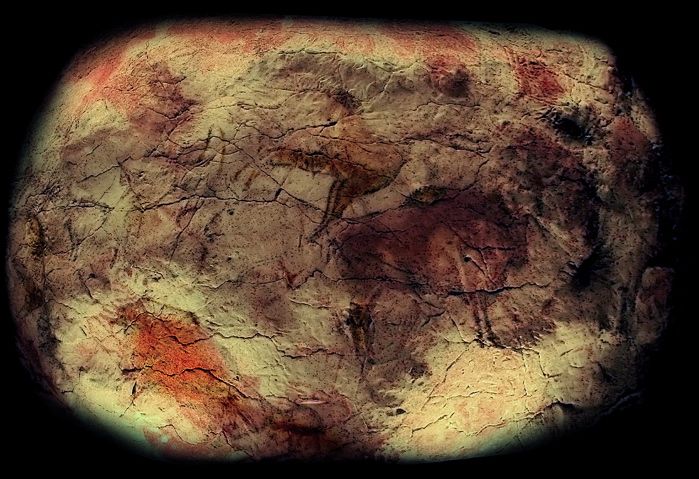
Photo: José-Manuel Benito, Public domain via Wikimedia Commons Source
A cave in Cantabria with painted bison ceilings, the first cave art to be recognized as Paleolithic. It dates from the 13th millennium BC and is associated with Magdalenian and Solutrean. It is a UNESCO World Heritage Site.
- Country
- Spain
- Region
- Europe
- Period
- about 36,000 to 13,000 years ago
- Kind of site
- Cave with prehistoric art, Stone Age site, monument
- Dates from
- 13th millennium BC
- Period or culture
- Magdalenian, Paleolithic, Solutrean
- Heritage status
- Bien de interés cultural; Part of UNESCO World Heritage Site; World Heritage Site
- Located in
- Santillana del Mar, Spain
- Also known as
- Cuevas de Altamira; Cave Paintings, Altamira Cave
- Coordinates
- 43.3825° N, 4.1203° WWikipedia and Wikidata agree within 0.62 km
- UNESCO
- World Heritage site 310
- Reference
- Wikidata Q133575
- Encyclopedia
- Wikipedia article
About this place
The Cave of Altamira is a cave complex, located near the historic town of Santillana del Mar in Cantabria, Spain. It is renowned for prehistoric cave art featuring charcoal drawings and polychrome paintings of contemporary local fauna and human hands. The earliest paintings were applied during the Upper Paleolithic, around 36,000 years ago. The site was discovered in 1868 by Modesto Cubillas and subsequently studied by Marcelino Sanz de Sautuola. Aside from the striking quality of its multicolor art, Altamira's fame stems from the fact that its paintings were the first European cave paintings for which a prehistoric origin was suggested and promoted. Sautuola published his research with the support of Juan de Vilanova y Piera in 1880, to initial public acclaim.
Adapted from the Wikipedia article Cave of Altamira (this version), lightly edited for style, under the CC BY-SA 4.0 license.
Nearby places
Open in the Atlas →- La Masera 6.8 km (4.2 mi)
- Giant stele 12 km (8 mi)
- Cueva de Hornos de la Peña 15 km (10 mi)
- Cave of El Castillo 16 km (10 mi)
- Cave of Las Monedas 16 km (10 mi)
- Cueva de La Pasiega 16 km (10 mi)














Recent comments