

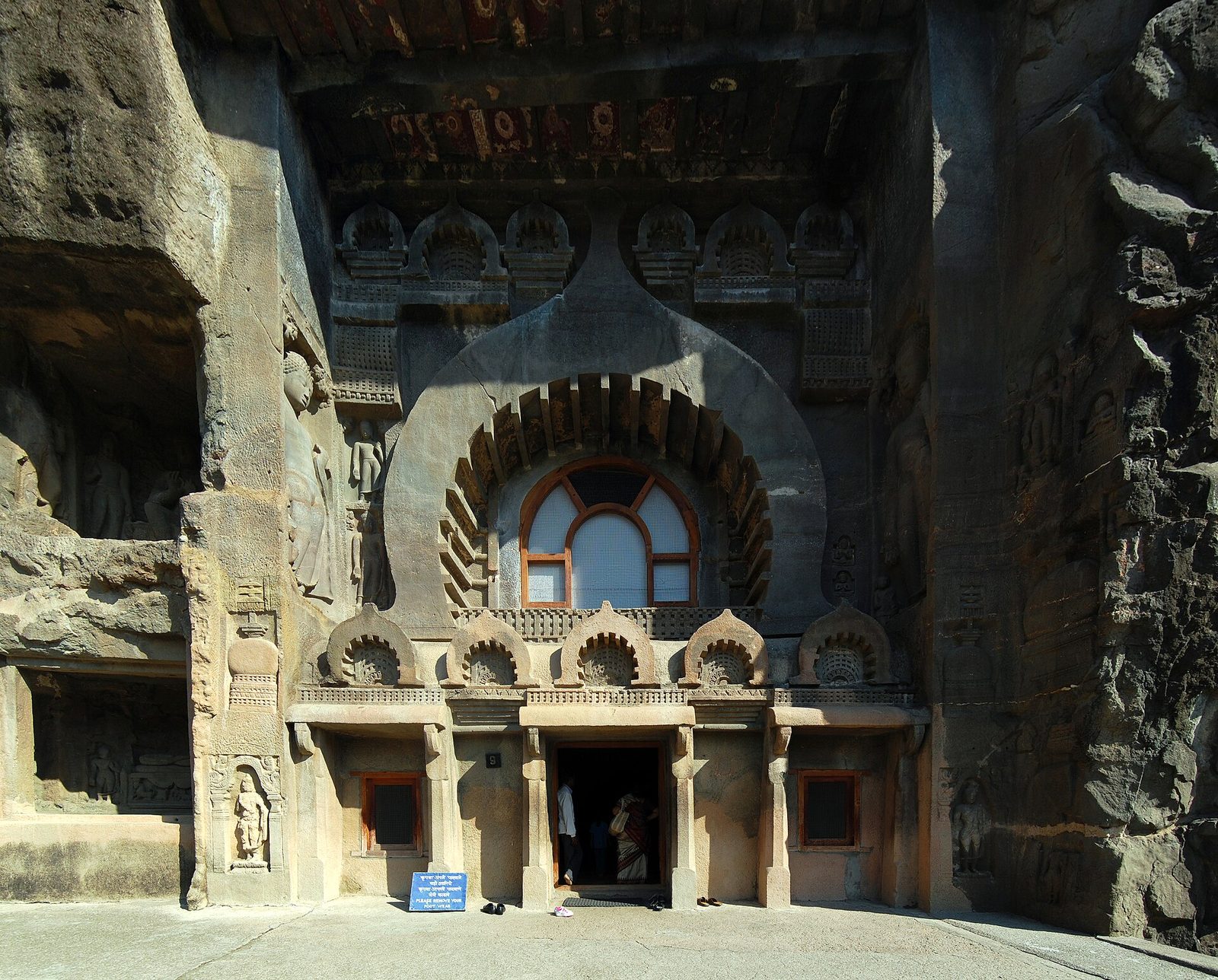
Photo: Marcin Białek, CC BY-SA 4.0 via Wikimedia Commons Source
Rock-cut Buddhist monasteries with celebrated wall paintings. It dates from the 2nd century BC. It is a UNESCO World Heritage Site.
- Country
- India
- Region
- Asia
- Period
- 2nd century BC to AD 480
- Kind of site
- Grotto, artificial cave, temple
- Dates from
- 2nd century BC
- Heritage status
- World Heritage Site; Monument of National Importance
- Located in
- Aurangabad district, India
- Coordinates
- 20.5533° N, 75.7003° EWikipedia and Wikidata agree within 0.02 km
- UNESCO
- World Heritage site 242
- Reference
- Wikidata Q184427
- Encyclopedia
- Wikipedia article
About this place
The Ajanta Caves are 30 rock-cut Buddhist cave monuments dating from the second century BCE to about 480 CE in Aurangabad district of Maharashtra state in India. Ajanta Caves are a UNESCO World Heritage Site. Universally regarded as masterpieces of Buddhist religious art, the caves include paintings and rock-cut sculptures, described as among the finest surviving examples of ancient Indian art, particularly expressive paintings that present emotions through gesture, pose and form. The caves were built in two phases, the first starting around the second century BCE and the second occurring from 400 to 650 CE, according to older accounts, or in a brief period of 460 to 480 CE according to later scholarship. The Ajanta Caves constitute ancient monasteries (Viharas) and worship-halls (Chaityas) of different Buddhist traditions carved into a 75-meter (246 ft) wall of rock.
Adapted from the Wikipedia article Ajanta Caves (this version), lightly edited for style, under the CC BY-SA 4.0 license.
Nearby places
Open in the Atlas →- Ellora Caves 80 km (50 mi)
- Chichali 179 km (111 mi)
- Mandu 200 km (124 mi)
- Ambivali Caves 287 km (178 mi)
- Ujjain 292 km (182 mi)
- Ancient site, Kayavarohan 305 km (190 mi)














Recent comments