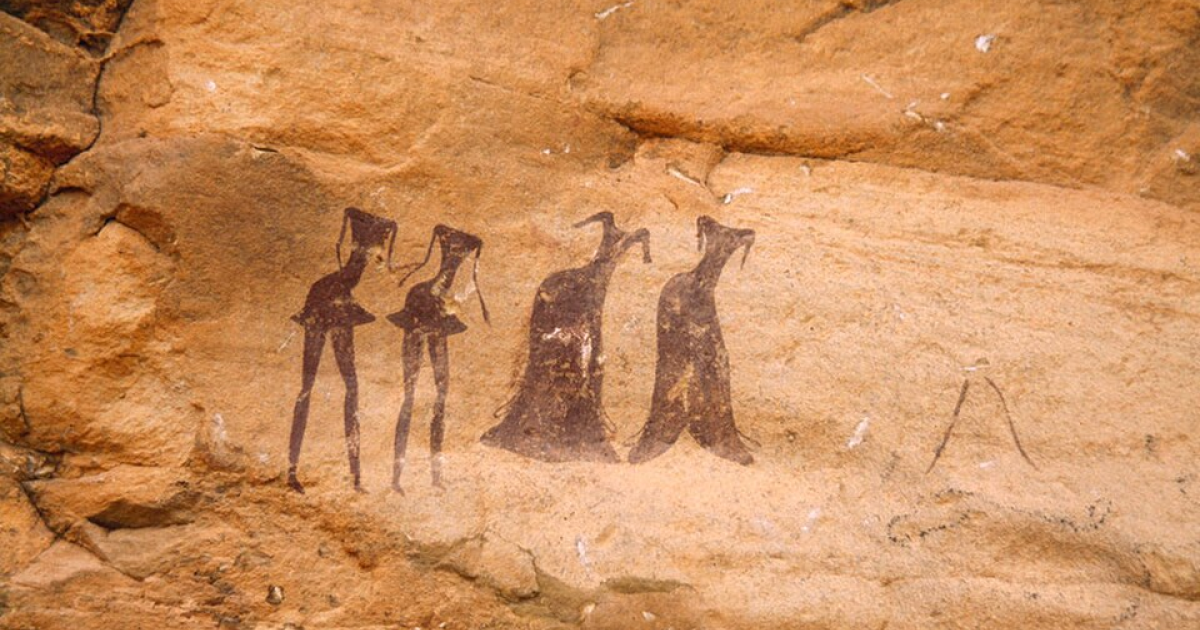

Hidden deep within the sandstone plateaus of Tassili n'Ajjer, the central Sahara Desert holds one of humanity’s oldest surviving art galleries. Across cliffs, caves, and rock shelters, prehistoric artists rubbed ochre pigment into sandstone to create scenes of daily life, ritual, and survival. Herds of cattle roam across stone walls, hunters stalk wild animals, and mysterious round-headed figures roam beneath the desert sky. These paintings reveal a forgotten world 10,000 years old. Once, the Sahara was not a barren expanse, but a fertile landscape filled with rivers, wildlife, and thriving communities. The rock art of Tassili n’Ajjer offers more than primitive artworks — it serves as a vivid window into the lives, beliefs, and dramatic environmental changes that shaped prehistoric North Africa.
- Oldest Cave Art? 67,800-Year-Old Hand Stencil Found in Sulawesi
- Uncertain Origins of Ancient Cave Paintings Found in the Yucatan Peninsula
Africa’s Largest National Park Is Now a UNESCO World Heritage Site
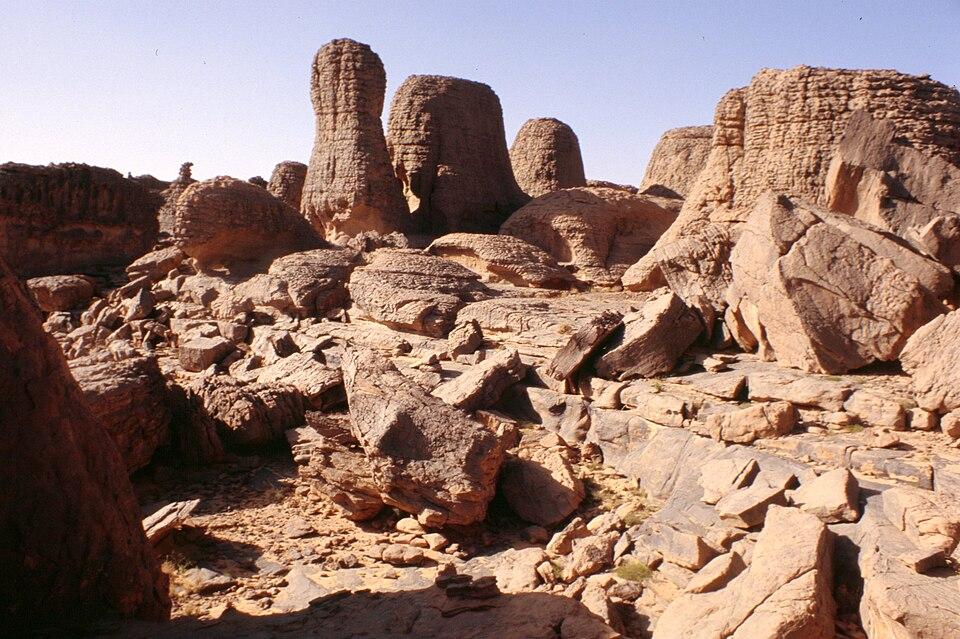
Stone towers rise from the sand in Algeria’s Tassili n’Ajjer UNESCO World Heritage Site. (CC-BY-SA 2.0)
The Tassili n'Ajjer region, covering 72,000 square kilometers, is located on an enormous plateau in southeastern Algeria, at the borders of Libya, Niger, and Mali. The area is a time capsule that has preserved the remains of successive communities. The landscape is hundreds of millions of years old. Today, it is a barren desert, but during the Silurian and Devonian periods, the region lay beneath ancient seas. Archaeological excavations have uncovered tools, pottery, and burial mounds that provide insight into early human civilization. Researchers have documented more than 15,000 prehistoric engravings and paintings at Tassili n’Ajjer. Historians have a visual record spanning thousands of years of climate change, wildlife migrations, and human societies' practices. Biologists catalogue the unique plants and animals that abound in this biodiverse area. Tassili n’Ajjer is a remarkable archive that was designated as a UNESCO World Heritage Site in 1982.
Archaeological Exploration Began in the Early 1900s
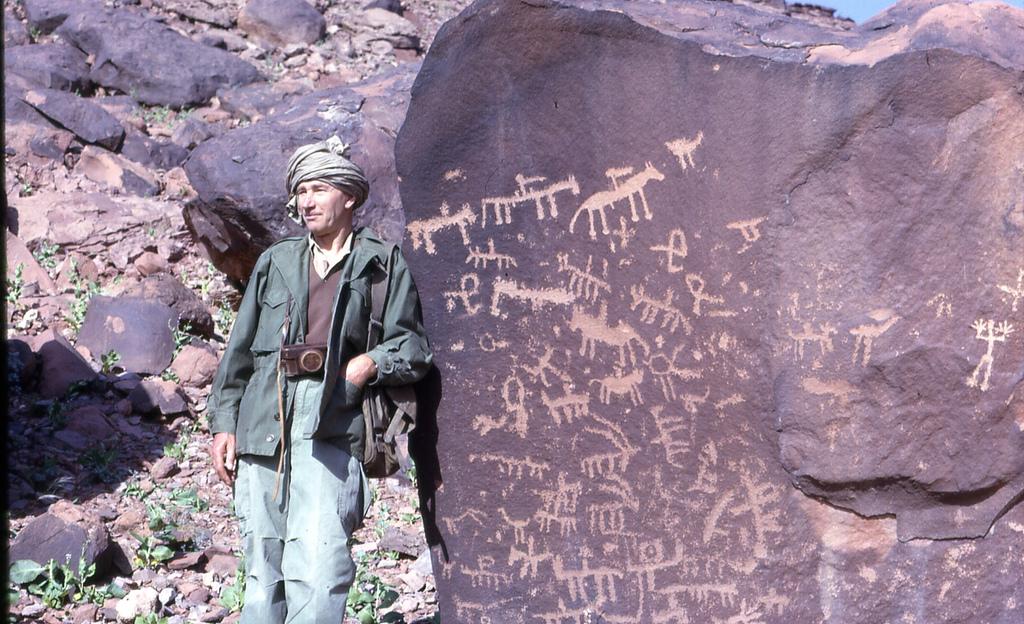
French explorer Henri Lhote made the Tassili n’Ajjer site famous, but drew criticism for his techniques that damaged the fragile artworks. (John Atherton/CC-BY-SA 3.0)
European archaeologists began to visit the Tassili n’Ajjer in the early 1900s, drawn by local legends about the murals and reports of visitors to local Tuareg communities. In the 1950s, the French explorer Henri Lhote led expeditions and documented his discoveries in books and academic journals. His techniques began debates over the interpretation of the paintings and the methods he used to study the site.
Lhote began the exploration, but art historians, scientists, and archaeologists used his work to make detailed studies of the 15,000 paintings and engravings in the shelters and caves. Researchers believe that more will be found in less accessible areas. It is the most significant collection of prehistoric rock art in the world. The oldest works are approximately 12,000 years old.
- New Technology Finds Barely Visible 28,000-year- old Cave Paintings in Spain
- Archaeologists Discover Nearly 5,000 Cave Paintings in Mexico
Art Historians Divide Paintings and Engravings into Stylistic Periods
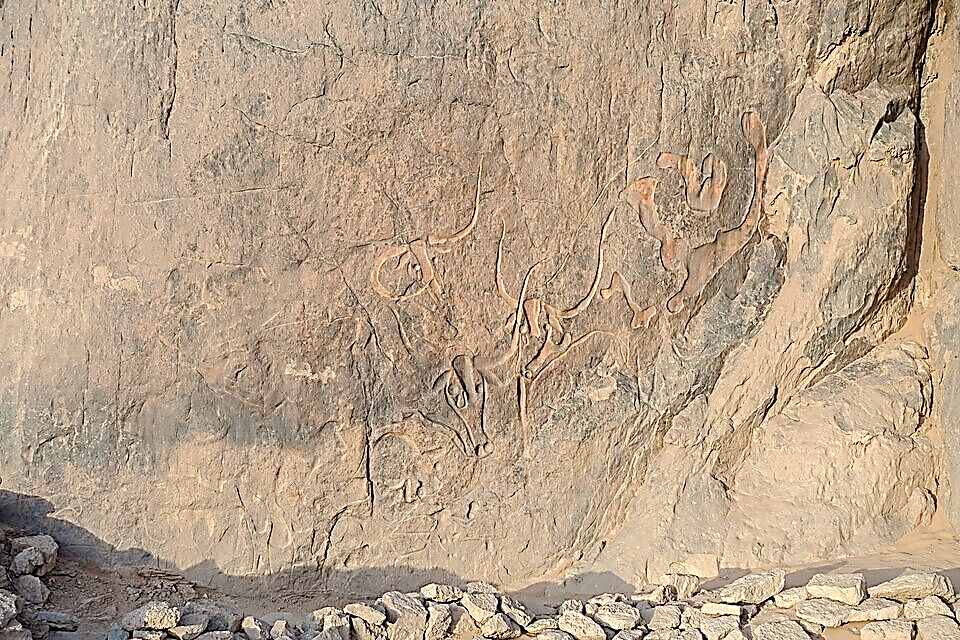
An engraving, “The Crying Cow”, shows the grieving cattle who long for the rains to return (CC-BY-SA 4.0).
Scholars divide the paintings into stylistic traditions. The earliest is the Archaic Period, which includes engravings of large wild animals. The Round Head Period features human figures with circular heads. The Pastoral Period, 4500-4000 BCE, has scenes of animal herds and the daily life of the herders. Scientists note that these scenes signal climate change since they record a shift from the hunter-gatherers who hunted the large animals to an environment in which cattle can graze vast grasslands. The styles change as horses, chariots, and camels appear in the murals, signaling a drier climate where grasslands give way to the desert.
Art historians point out that a famous engraving, the Crying Cow, between 7,000 and 8,000 years old, does not fit into its period. Though it is older than the Pastoral Period, it shows cattle with a large tear beneath one eye. Local legends explain that the cattle are grieving the failure of the rains to come, further drying the grasslands.
The Story of the Sahara Carved into Cave Walls and Rocky Towers
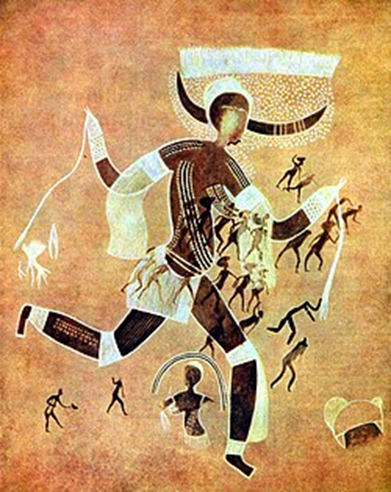
Round Head dancers perform a ritual ceremony wearing horns and flowing cloth. (Credit to Wikimedia Commons / The Yorck Project, PD, artwork reproduction. The Yorck Project compilation is licensed under the GNU Free Documentation License (GFDL).
Tassili n’Ajjer’s murals are a timeline of climate change in the Sahara Desert. The oldest artworks show grazing antelopes drinking from the waterholes. Giraffes eat tender leaves while crocodiles and hippos dive in large rivers. The Sahara experienced dramatic change between 12,000 and 7,000 years ago during the African Humid Period. Monsoon rains expanded north of their modern range. Later, the rains changed course, and the water-rich environment became arid. Without the seasonal rains, farmers became nomads, large herds dwindled, and the green landscape dried to rocks and sand. Each step of environmental change is documented in the region’s ancient artwork.
Modern Challenges for Prehistoric Art: Access and Preservation
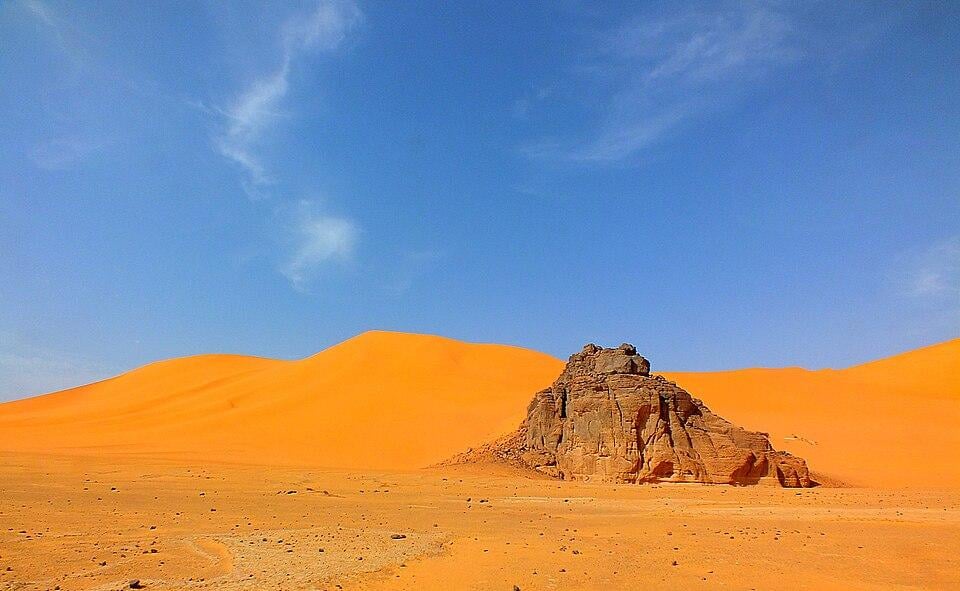
The Sahara’s winds and sand constantly weather the stones, presenting preservation challenges for archaeologists. (CC-BY-SA 5.0).
The prehistoric murals present significant challenges for access and preservation. The first challenge is location-- an arid world of windstorms and high temperatures that threaten fragile artworks. Another challenge is a lack of security in an enormous area that defies reliable monitoring. Even researchers can be a danger to the ancient art. Though Henri Lhote helped the site with his writings and photographs, his methods included wetting the pigments so that his pictures would be more colorful. Art preservationists intervened to insist on less harmful practices. Algerian authorities have taken over site management through the National Office of the Tassili n’Ajjer Cultural Park. They emphasize controlled tourism so that visitors can only visit on foot with official guides.
Saharan Transformation from Savanna to Sand in the Oldest Open-Air Art Exhibition
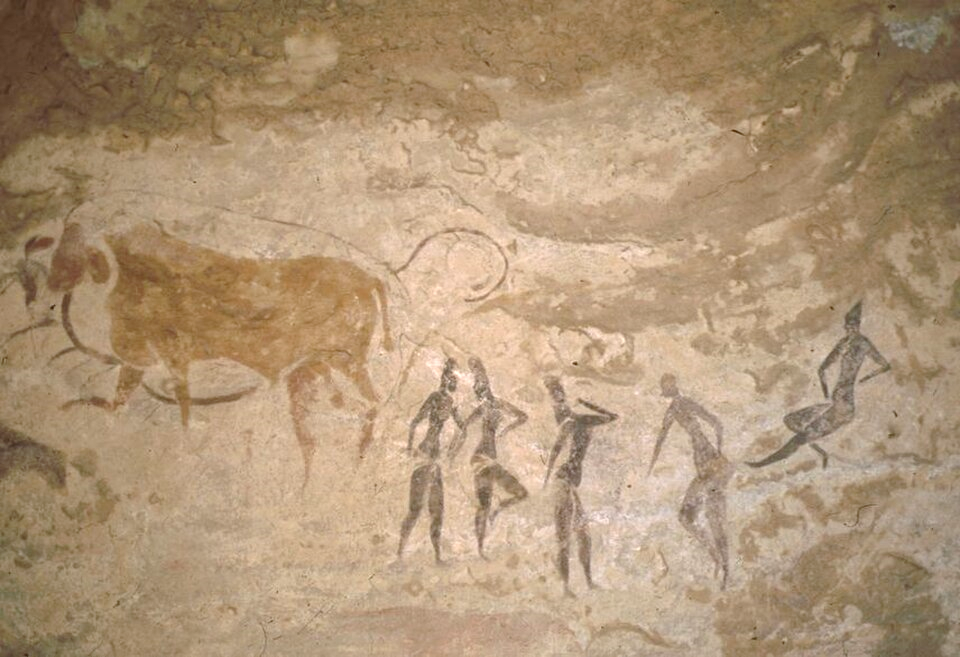
Dancers celebrate near a large buffalo with curving horns. (CC-BY-SA 6.0)
In English, the translation of Tassili n’Ajjer is the plateau of rivers. Though its name described the past, the rock walls predicted the future. As the Sahara began its transformation from grassy savanna to desert, its people displayed their emotional attachment to the land and animals around them. The powerful forces of nature shaped their livelihood, their homes, and their environment. Their art presents a legacy and a lesson: man must adapt to survive.
Top image: Source:
By Ramsey Hardin
References
Department of the Arts of Africa, Oceania, and the Americas. “African Rock Art: Tassili-N-Ajjer (?8000 B.C.–?) - The Metropolitan Museum of Art.” African Rock Art: Tassili-n-Ajjer (?8000 B.C.–?), October 2000. https://www.metmuseum.org/essays/african-rock-art-tassili-n-ajjer-8000-b-c.
Hawkins, Jack. “Researchers Uncovered More than 15,000 Rock Carvings in Tassili n’Ajjer, Algeria, Depicting Extinct Animals and Possible Ancient Shamanic Rites.” Researchers uncovered more than 15,000 rock carvings in Tassili n’Ajjer, Algeria, depicting extinct animals and possible ancient shamanic rites. Accessed May 27, 2026. https://www.splashtravels.com//world-history/researchers-uncovered-more-15000-rock-carvings-tassili-najjer-algeria-depicting-extinct-animals-and-possible-ancient-shamanic-rites.
Murphy, Richard, ed. “Tassili n’Ajjer: The Sahara’s Open-Air Museum.” Opec Bulletin: Riyadh’s New Black Gold Museum, March 3, 2026. https://www.opec.org/assets/assetdb/bulletin-2026-03.pdf.
Petricevic, Ivan. “Tassili n’ajjer’s Painted World Still Defies the Desert.” Tassili n’Ajjer’s Painted World Still Defies the Desert, March 21, 2026. https://curiosmos.com/tassili-najjers-painted-world-still-defies-the-desert/
“Tassili n’Ajjer - UNESCO World Heritage Centre.” Tassili n’Ajjer. Accessed May 27, 2026. https://whc.unesco.org/en/list/179.
The British Museum, "Prehistoric rock art in North Africa," in Smarthistory, September 23, 2016, accessed May 27, 2026,https://smarthistory.org/rock-art-north-africa/.
“Trust for African Rock Art - Prehistoric African Paintings and Engravings.” Trust For African Rock Art - Prehistoric African Paintings and Engravings. Accessed May 27, 2026. https://africanrockart.org/.
Vidar. “Ancient Art of Tassili n’ajjer: 12,000-Year-Old Window into Sahara’s Past.” Ancient Art of Tassili n’Ajjer: 12,000-Year-Old Window into Sahara’s Past, March 8, 2026. https://streetartutopia.com/2025/04/20/ancient-art-of-tassili-najjer-12000-year-old-window-into-saharas-past/.